Pengertian Possessive Adjective
Possessive adjective adalah determiner (special adjective) yang digunakan untuk menyatakan kepemilikan (possession) terhadap noun. Adjective ini terdiri dari my, your, his, her, its, our, dan their.
Contoh Possessive Adjective
- my books (buku saya)
- your father (ayahmu)
- our class (kelas kita)
- their offer (tawaran mereka)
- his last name (nama belakangnya)
- her skirt (roknya)
- its tail (ekornya)
Contoh Kalimat Possessive Adjective
- Your father just left five minutes ago.
(Ayahmu baru saja pergi lima menit lalu.) - He has accepted their offer.
(Dia telah menerima tawaran mereka.) - I didn’t even know his last name.
(Saya bahkan tidak mengetahui nama belakangnya.)

Possessive Pronoun dan Adjective
Possessive adjective memiliki bentuk yang mirip dengan possessive pronoun. Perbandingannya dapat dilihat pada tabel berikut.
| Person | Number | Posessive Pronoun |
|---|---|---|
| 1st | Singular | mine |
| 2nd | yours | |
| 3rd | hers, his | |
| 1st | Plural | ours |
| 2nd | yours | |
| 3rd | theirs | |
| Person | Number | Possessive Adjective |
| 1st | singular atau plural | my |
| 2nd | your | |
| 3rd | her, his, its | |
| 1st | our | |
| 2nd | your | |
| 3rd | their |
Pronoun berfungsi mengantikan noun yang dapat berupa singular (mine, yours, hers, his, its) atau plural (ours, yours, theirs). Jika pronoun yang berperan sebagai subjek kalimat berupa singular, maka verb yang mengikuti berbentuk singular, begitupun sebaliknya.
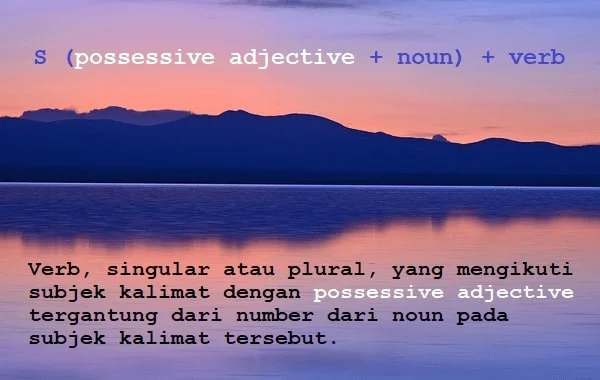
Sedangkan semua possessive adjective dapat digunakan bersama singular maupun plural noun. Ketika noun yang berperan sebagai subjek kalimat berupa singular, maka diikuti verb berbentuk singular, berlaku sebaliknya.
Contoh Kalimat Possessive Pronoun dan Adjective
- Mine is the biggest one. / My house is the biggest one.
(Milikku adalah yang terbesar. / Rumahku adalah yang terbesar.) subject - The city is mine. / The city is my hometown.
(Kota tsb milikku. / Kota tsb adalah kampung halamanku.) subject complement - Yours was sent yesterday. / Your letter was sent yesterday.
(Milikmu dikirim kemarin. / Suratmu dikirim kemarin.) subject - Yours were sent yesterday. / Your letters were sent yesterday. subject
- Today is yours. / Today is your day.
(Hari ini milikmu. / Hari ini harimu.) subject complement - Hers is beautiful. / Her skirt is beautiful.
(Miliknya cantik. / Rok dia cantik.) subject - It is not his. / It is not his car.
(Itu bukan miliknya. / Itu bukan mobilnya.) subject complement - I like his. / I like his car.
(Saya suka miliknya. / Saya suka mobil dia.) object - – / That puppy wagged its tail.
(Anak anjing itu mengibaskan ekornya.) - Ours is on the table. / Our key is on the table.
(Milik kita di atas meja. / Kunci kita di atas meja.) subject - That is ours. / That is our class.
(Itu milik kita. / Itu kelas kita.) subject complement - They found ours. / They found our key.
(Mereka menemukan milik kita. / Mereka menemukan kunci kita.) object - Theirs are the official rules. / Their rules are the official rules.
(Punya mereka adalah peraturan resmi. / Peraturan mereka adalah peraturan resmi.) subject - Some of the good books are theirs. / Some are their own.
(Beberapa dari buku bagus tsb adalah milik mereka. / Beberapa adalah milik mereka.) subject complement
Posisi di dalam Noun Phrase
Possessive adjective tepat berada di depan simple noun atau dapat disela oleh determiner lain maupun adjective (sebagai modifier) pada noun phrase. Sebagai informasi, adjective ini merupakan salah satu dari central determiner, yaitu determiner yang diletakkan diantara pre dan post-determiner pada suatu noun phrase.
Contoh
- your choice [determiner “possessive adj” (your) + noun (choice)]
- two-third his salary [predeterminer “fraction” (two-third) + central determiner “possessive adj” (my) + noun (salary)]
- my funny cat [determiner “possessive adj” (my) + modifier “adjective” (funny) + noun (cat)]
10 Contoh Soal Possessive Adjective Pilihan Ganda
Pilihlah possessive adjective yang tepat untuk melengkapi kalimat di bawah ini dengan mengetik a, b, c, atau d.
Dr. John and the team are committed to delivering the highest quality product to ... clients.
Your answer:
Andrian just bought a used car. ... car has manual locks.
Your answer:
The woman gets up before dawn and sells fruits and vegetables at the farmer's market to pay for ... daughter's college tuition.
Your answer:
I love swimming. Sometimes I go to public swimming pool with ... family.
Your answer:
Please take ... shoes off before entering the room.
Your answer:
Someone has left ... watch in the bathroom.
Your answer:
Why do a cat chase ... tail?
Your answer:
The lawyer or his assistants will ask some questions about your case in ... office.
Your answer:
My husband and I found two dead mice in ... sink a couple days ago.
Your answer:
Some eliminate fast food from ... daily diet.
Your answer:
Javascript diperlukan untuk menjalankan quiz ini.
Lihat juga:
References:
- faculty.mdc.edu. Accessed on April 4, 2013.
- press.umich.edu. Accessed on October 16, 2012.
- mit.edu. Accessed on October 16, 2012.
- myenglishpages.com. Accessed on November 13, 2014.


Hi
can you explain about adjective clause “whose” but use “possesive adjective”
Thanks
Hi Fariz,
Please give me an example of it.
this
This is the girl whose picture you saw
I don’t see any possessive adjectives in this sentence. 🙁
before change adjective clausee “whose” introductory word function as: Possesive adjective
=This is the girl, you saw her picture
after change adjective clausee “whose” introductory word function as: Possesive adjective
=This is the girl whose picture you saw
so, can you explain the reason ?
Thank you 😀
So we have two short sentences:
*This is the girl.
*You saw her picture.
and want to combine them into a longer, more effective sentence by using the second sentence as an adjective clause. All we have to do is eliminate repetitive (or corresponding) word. It is “her” that corresponds to the girl. “Her” is a possessive, so we use “whose”.
who = subject pronoun
whom = object pronoun
whose = possessive
Hope this helps 🙂
Mbak, mau tanya, saya kan belajar di sekolah begini:
I – My – Mine – Me
Nah, kalo it itu terakhirnya apa? Its atau it saja?
Terima kasih
Halo Zack 🙂
I – my – mine – me = subjective personal pronoun – possessive adjective – possessive personal pronoun – objective personal pronoun
berarti it – its – its – it.
Can you tell me more specific about the differences between it and its? Thanks
Hi Alvan,
You can use “its” either as a pronoun (possessive) or possessive adjective (determiner). “it” is only used as a pronoun (subjective or objective).
Some examples…
(possessive personal pronoun)
Its color is black. (possessive adjective)
It has just been raining. (subject)
I removed it yesterday. (object)
UPDATE:
Materi It’s vs. Its
I got it mbk Wilma
Thanks a lot 😉
It will be great if you give more specific explanation about pronoun so the readers will be easy to understand. As i know, many articles is written without detail explanation. The writer only writes and gives an explanation in general.
Just like me, i got problem to know how its and it become not same 😉
But anyway, thank you for the anwer mbk Wilma 🙂
Actually I’ve written about it’s vs. Its separately (I found it after using the search button -_-), but I haven’t linked the page to this page yet. I know how you feel. Good writers should be able to write for their readers, not only for themselves. Readers come from different educational backgrounds and have different purpose for reading. Some look for general overview, some look for detail.
Btw the example of “its” as a pronoun is (so) rare. It seems “its” is possible to use as it, but not common.
mba Wilma, mau tanya, dari 2 kalimat ini mana yang benar? 1.Mobil kami baru – our car is new 2.Rumah mereka besar – their car is big
Hi Laura,
1. Mobil kami baru –> Our car is new. (benar)
2. Rumah mereka besar –> Their car is big. (salah)
Their house is big. (benar)
Semoga membantu… 🙂
Thank you for this article .. very useful for us.. Like this blog